 Printing Planet UK
What a Roller Banner Is and How It Works
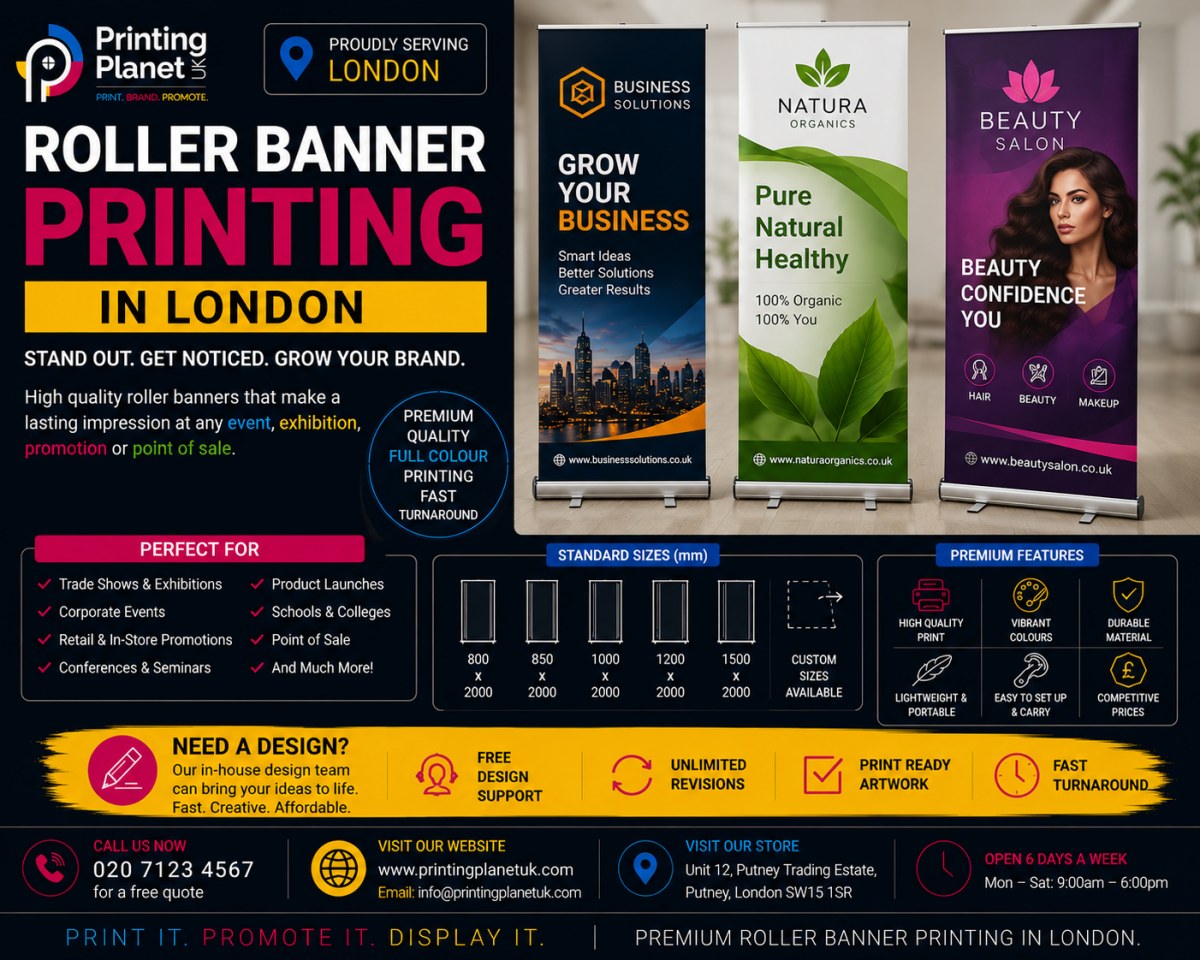
A roller banner (also called a pull-up stand or pop-up banner) houses a printed graphic inside a cassette at the base. The graphic rolls up into the cassette when not in use and pulls upward to clip into a top pole for display. The whole unit assembles in under a minute without tools and packs flat into a carry bag.
The mechanism uses a spring-loaded cassette. Over time, repeated pulls can weaken the spring, so handling the banner smoothly rather than yanking it matters for longevity.
Standard Sizes
| Size | Common Use |
|---|---|
| 800 x 2000 mm | Narrower stands, tighter floor space |
| 850 x 2000 mm | Most popular general-purpose size |
| 1000 x 2000 mm | Wide-format, high-visibility displays |
| 1200 x 2000 mm | Exhibition backdrops, large venues |
The 850 x 2000 mm size suits most retail, conference and event applications. It fills the field of view at three to four metres distance without dominating a small booth.
Polyester vs Vinyl: Which Material to Choose
| Property | Polyester Film | Vinyl |
|---|---|---|
| Weight | Lighter | Heavier |
| Print quality | Excellent colour saturation | Very good |
| Durability | High (resists creasing) | High (more flexible) |
| Indoor use | Ideal | Suitable |
| Outdoor use | Not recommended | Suitable for sheltered spots |
| Cost | Slightly higher | Standard |
Polyester film is the preferred choice for indoor events, showrooms and retail because it holds colour well and resists the creasing that can appear when vinyl is rolled repeatedly. Vinyl is a reasonable option when budget is the primary concern or the banner needs occasional sheltered outdoor use.
Roller Banner vs PVC Banner vs Feather Flag
Each format solves a different problem.
Roller banner works best indoors where stability matters, floor space is limited and the display needs to look professional close-up. It is self-standing and portable.
PVC banner suits large outdoor or semi-permanent installations. It attaches to walls, fences, scaffolding or frames. It does not stand alone and needs fixing points. PVC handles weather well and costs less per square metre at large sizes.
Feather flag is designed for outdoor footfall. The curved shape and movement in the breeze attract attention from a distance. It suits forecourts, markets and roadside positions. It is less suitable for reading detailed text.
| Format | Best Environment | Self-Standing | Weather Resistance |
|---|---|---|---|
| Roller banner | Indoor events, retail | Yes | Low |
| PVC banner | Outdoor, semi-permanent | No | High |
| Feather flag | Outdoor, high footfall | Yes (with ground spike) | Medium to high |
Artwork Setup: Safe Zone and Bleed
Getting artwork dimensions right prevents cropped logos or white edges on the finished print.
Bleed: Add 20 mm to each side of the graphic beyond the finished size. For an 850 x 2000 mm banner the artwork file should be 890 x 2040 mm.
Safe zone: Keep all critical content (text, logos, faces) at least 25 mm inside the finished trim line. The cassette at the base covers roughly the bottom 100 mm of the graphic, so place no important content below that point.
Resolution: Supply files at 100 to 150 dpi at full print size. Scaling a low-resolution file up to banner size produces visible pixelation.
Colour mode: Use CMYK. RGB files are converted at print stage and colours may shift, particularly deep blues and purples.
File format: PDF (press-quality) or TIFF. Flatten transparency before exporting.
Care Tips
Store the banner rolled inside its cassette and carry bag when not in use. Avoid leaving it assembled in direct sunlight for extended periods, as UV exposure fades print over time. Wipe the graphic with a dry or slightly damp cloth only. Solvents damage the print surface. Check the top pole clip before each use and replace the pole if it develops a crack, as a broken pole causes the banner to lean and risks toppling.
For more detail on available sizes and finishing options, visit the roller banners service page.