 Printing Planet UK
Two Different Technologies
Vinyl transfers (also called HTV, heat-transfer vinyl): a cutter slices shapes out of coloured vinyl sheets. You weed out the excess, layer up colours one at a time, and press each layer. The result is a solid, slightly raised print.
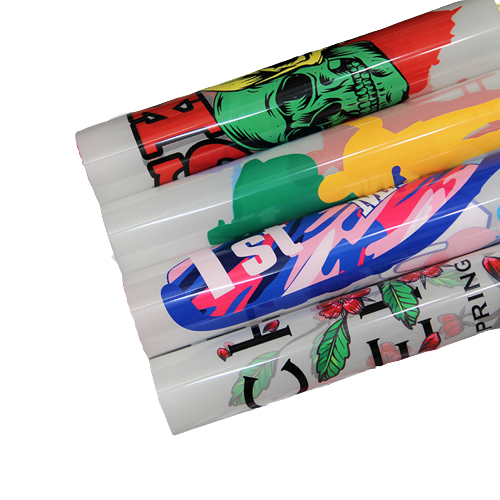
DTF transfers: designs are printed digitally in full CMYK colour onto a PET film with a white underbase and hot-melt adhesive. You press the whole thing at once. Gradients, photos, and hundreds of colours are all possible in a single press.
Where Vinyl Wins
Simple, solid-colour designs - a two-colour logo, a team name, a single-colour number. Vinyl cuts cleanly, feels solid, and lasts well on these.
Metallic and specialty finishes - vinyl comes in glitter, chrome, holographic, and flock variants. DTF cannot replicate these finishes.
Very small text - a vinyl cutter can produce sharper lettering on very small text (below 8 mm tall) than a DTF printer.
Low volume of one colour - if you are pressing 10 shirts with a plain white logo, a roll of white vinyl is cheaper than ordering a DTF gang sheet.
Where DTF Wins
Photographic and multicolour artwork - gradients, shadows, skin tones, detailed illustration. Vinyl requires a separate layer for each colour; a 10-colour design would take 10 separate sheets and cuts. DTF prints it in one step.
No weeding - vinyl requires weeding out the negative space, which is time-consuming on detailed designs. DTF has no weeding step.
Faster production - one press, one step. No layering, no alignment errors between layers.
Smaller designs - small stickers, badge prints, and pocket logos work well with DTF without the fiddly weeding that vinyl requires at small sizes.
Soft hand feel - well-pressed DTF transfers have a softer feel on the fabric than vinyl, which sits on top of the fibres. For fashion-quality garments, DTF is generally preferred.
Gradients and transparent effects - vinyl cannot do transparent gradients. DTF handles them naturally because it is a printed process.
Side-by-Side Comparison
| Feature | DTF Transfers | Vinyl HTV |
|---|---|---|
| Full-colour photos | Yes | No |
| Gradients | Yes | No |
| Metallic finishes | No | Yes |
| Weeding required | No | Yes |
| Setup per colour | None | One layer per colour |
| Small text clarity | Good | Better under 8 mm |
| Hand feel | Soft | Slightly raised |
| Best for | Detailed, multicolour art | Solid, simple logos |
| Wash durability | 50 plus washes | 50 plus washes (similar) |
Which Is Cheaper?
For simple one or two colour designs ordered in bulk, vinyl can be cheaper because it requires minimal equipment and the material cost per press is low.
For complex artwork, DTF is almost always cheaper. A 6-colour vinyl design requires 6 cuts, 6 weeding sessions, and 6 presses. The same design on a DTF transfer is one press at one price.
Can You Use Both?
Many garment decorators keep both. Vinyl for team names and simple logos, DTF for the complex, full-colour work. They are complementary tools.
Order DTF Transfers in London
For complex, full-colour, or photographic designs, DTF transfers from Printing Planet UK are the practical choice. We print on 60 cm wide film at £15 per metre with same-day collection from Putney.
Not sure which method suits your design? Email it to us and we will advise for free.